
Pip: There’s a particular kind of courage in writing about cancer, faith, and the state of the world all at once — and then handing someone a prayer card for good measure.
Mara: C. Joyce Farrar-Rosemon does exactly that across these posts — covering healing through faith and affirmation, spiritual perseverance through some genuinely turbulent territory, and questions of justice, belonging, and peace.
Pip: Let’s start with healing — and what it might mean to reach for something when medicine alone hasn’t been enough.
Healing Through Faith and Affirmation
Mara: The posts here open with a specific kind of dare — not a metaphor, but a direct invitation to bring cancer before God in prayer, modeled on a woman in scripture who had been ill for twelve years.
Pip: And the anchor text doesn’t soften it. From “Discover the Power of Prayer for Cancer Healing,” the call is direct: “Confess your faults one to another and pray one for another that ye may be healed. The effectual fervent prayer of a righteous man availeth much.”
Mara: What that means in practice is that prayer is framed here as active, communal, and consequential — not passive comfort, but something you do alongside your oncology team, not instead of it.
Pip: “Your Cancer Healing is a Touch Away” covers the same scriptural ground, which tells you something about how central that story of the woman with the bleeding disorder is to this whole framework — it’s the load-bearing image.
Mara: And “Daily Affirmations for Cancer Recovery” gives that framework a daily shape. Lines like “Every cell, tissue, nerve, organ, blood vessel, and bone is responding to God’s will that I am healthy” are written to be spoken aloud, repeated, internalized.
Pip: So the affirmation isn’t decoration — it’s the practice itself.
Mara: Right. “God Heard My Cry” and “By His Stripes We Are Healed” extend that into blessing and testimony — one drawn from Psalm 103, the other rooting healing in Isaiah 53:5, reaching well beyond cancer into what the posts call diseases of the mind, body, and spirit.
Pip: That’s a wide net — and it sets up the harder territory ahead.
Perseverance Through Spiritual Warfare
Mara: This segment asks a pointed question: what does it actually look like to hold ground when the world feels like it’s actively working against you?
Pip: The post “Are You Using Your God Ordained Power?” names the opposition directly — serpents and scorpions as stand-ins for forces that paralyze and torment — and then quotes Luke 10:19: “Behold, I give unto you power to tread on Serpents, and Scorpions, and over all the power of the enemy, and nothing shall hurt you.”
Mara: So the upshot is that the power is described as already given — the question the post poses is whether believers are actually using it.
Pip: Which connects to the warning in “I Shall Spew Thee Out Of My Mouth” — lukewarm faith as its own kind of surrender. Selective obedience, superficial prayer, living just like the world. That’s the Laodicea church getting a very uncomfortable letter.
Mara: “God Is Doing A New Thing, Can You Not Perceive It?” holds both of those in tension — acknowledging that travail is real and necessary, but insisting that joy comes in the morning. “Shall I Cause To Travail, And Not Bring Forth?” uses Rachel’s labor at Bethel to make the same point: suffering precedes the breakthrough, but the breakthrough is promised.
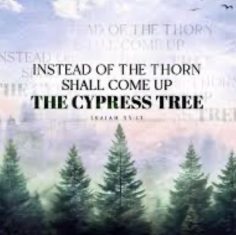
Pip: The image of thorns becoming fir trees in “For Thorns There Shall Grow Fir Trees” does similar work — hardship producing something medicinal, even fragrant.
Mara: And several posts name what faithful action looks like outwardly. “Loose The Bands of Wickedness” quotes Isaiah 58 on fasting as justice — feeding the hungry, housing the wanderer, covering the naked. “Take Up The Stumbling Blocks” calls believers to clear the path for others, naming specific leaders doing that work.
Pip: “Their Watchmen Cannot Bark” is the sharpest of these — leaders who sleep instead of warn, compared to the Basenji dog that won’t hunt in bad weather. That image lands.
Mara: “As The Hen Gathered Her Chickens” and “I Will Take Refuge Until the Disaster Has Passed” close the loop — God’s posture is relentless gathering, and David hiding in a cave still managed to offer praise. The call is to do the same.
Pip: Which is a natural bridge — because the next territory asks who belongs at the table to begin with.
Justice, Peace, and Who Belongs
Mara: The posts here start with identity — specifically, with the question of who gets to tell you who you are. “Who Told You That You Were Naked?” reads Genesis 3 as a template for every lie that tells a person they are worthless, uncovered, afraid.
Pip: And the counter-move is theological: “you are made in the image and likeness of God and by his stripes you are already healed.” That’s not therapeutic language — it’s a claim about ontology.
Mara: “God Loves Diversity” and “Who Are These Dressed In Long White Robes?” both reach toward a vision of belonging that crosses every national and ethnic line — a great multitude of all nations before the throne, which the posts read as God’s design from the beginning, not an afterthought.
Pip: “Blessed Are The Peacemakers” brings that down to Earth — literally, through the Artemis II astronauts describing Earth as a fragile lifeboat. And “Who Should Christians Vote For?” asks which politician most resembles the Good Samaritan: the one who crossed the road, stayed the night, and said charge the rest to my account.
Mara: The through-line across all of it is that belonging, healing, and justice aren’t separate concerns — they’re the same conversation, carried forward one day at a time.
Pip: Faith as a daily practice, perseverance as a posture, and belonging as something already promised — that’s a lot to carry into a Tuesday.
Mara: It is. And the posts suggest that’s exactly the point — next time, more from that same intersection of the personal and the prophetic.

